
Every week someone asks me some version of the same question: “Is AI going to replace graphic designers?”
I get why people ask. You can type a sentence into an app and get a logo-ish image back in ten seconds. That looks like the whole job, done for free.
But I’ve been doing small business design here in Edmond since 2007, and I can tell you where projects actually go wrong. It’s almost never because someone couldn’t make a picture. Projects go sideways because:
- The brief lived in three emails, a text, and a voicemail, and none of them matched.
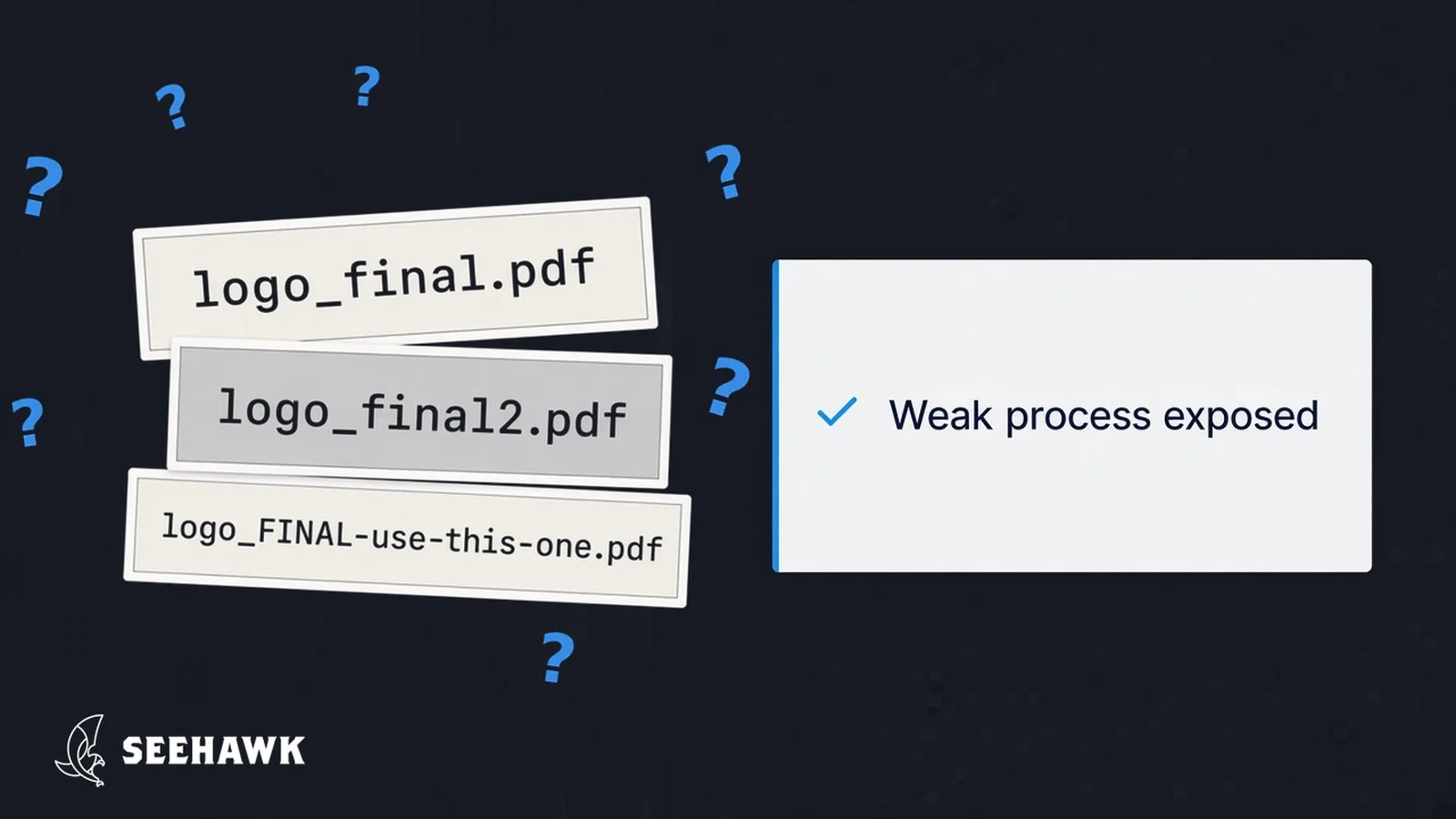
- Nobody knew which file was final. Was it
logo_final.pdf,logo_final2.pdf, orlogo_FINAL_use-this-one.pdf? - A print proof sat in someone’s inbox for nine days while the event date got closer.
- The “quick change” on round four quietly undid the fix from round two.
AI doesn’t fix any of that by itself. If anything, it makes it worse, because now you can produce more stuff, faster, with the same messy process underneath. AI won’t replace your designer. What it will do is show you exactly where your process is weak.
What AI is genuinely good at in a design studio
I’m not anti-AI. I use it, and we’ve built a service around it. In a working design studio, AI graphic design tools and assistants are good at the jobs that eat time but don’t take much judgment:
- First drafts of words. Proof-request emails, follow-ups on a quote that went quiet, rough social captions, a starting outline for a brochure.
- Sorting and summarizing. Turning a long email thread into “here’s what the client actually asked for, and here’s what’s still open.”
- Reminders. “This proof has been out for five days.” “The menu reprint is due before the holiday hours change.”
- Repetitive file prep. Resizing a logo pack for every social profile, renaming exports so they follow the same pattern, building the same price-sheet layout with new numbers.
- Exploring ideas. Quick rough concepts and mood references to talk through before anyone gets attached to a direction.
That’s real time back. On a busy week, it’s hours. But notice what’s on that list: drafting, sorting, reminding, repeating. That’s legwork, not the decisions.
What still needs a human designer
Here’s where a person still earns their keep, and I don’t see that changing soon.
Taste. AI can make something that looks fine. “Fine” is the problem. Your brand has to look like you, not like the average of ten thousand other businesses. Knowing when a layout feels cheap, when a font is fighting the message, or when less is the better answer is a judgment call.
Brand risk. A generated image can look a lot like someone else’s trademark. A caption can promise something you can’t deliver. A rushed social post can say the wrong thing at the wrong time. Somebody has to catch that before it’s public, and that somebody should know your business.
Print physics. Screens forgive a lot. Paper doesn’t. Bleed, safe zones, CMYK vs. RGB, that dark blue that turns purple on a certain stock, a 300 dpi image vs. one that looks great on a phone and blurry on a 4-foot banner. I’ve seen plenty of “finished” AI-made files that would have cost a client a full reprint.
Client politics. The owner wants the logo bigger. The manager wants it smaller. The partner who hasn’t been on any of the calls wants it green. A tool can’t read the room, figure out who actually signs off, or know when to push back politely. That’s a human conversation.
The weak-process checklist
If you’re a small business owner, run through this. If you check more than two, AI will speed up the mess, not fix it:
- Your project requests come in through four or more channels (email, text, DMs, hallway).
- Nobody can say in ten seconds which file is the current version.
- Proofs go out with no due date for feedback.
- Revisions stack up with no record of what changed and why.
- You don’t have a single folder where your logo pack, colors, and fonts live.
- You’ve reprinted something in the last year because of a missed detail.
- Follow-ups depend on someone remembering to send them.
- “Approved” sometimes means a thumbs-up emoji from someone who isn’t the decision-maker.
None of these is a design problem. They’re process problems, and they’re very fixable.
How Wingman fits
This is why we built SEEHAWK Wingman. Think of it this way: you’re the pilot, and we fly on your wing, keeping an eye on the details so you can keep yours on the business.
Wingman is a managed AI assistant service. We set up and run AI assistants inside the accounts you already use, and they handle the legwork:
- Sorting your inbox so the urgent proof approval doesn’t get buried under newsletters.
- Drafting replies, quote follow-ups, and social posts in your voice.
- Reminding you (and your customers) when a proof, a reprint, or a deadline is coming up.
- Keeping recurring jobs like price-sheet updates and file prep done the same way every time.
Two things don’t change.
First, SEEHAWK still owns design quality. The assistants draft and sort. A real designer handles the parts that need taste, brand judgment, and print know-how, the same way we have for nearly two decades.
Second, nothing goes out until you approve it. Every customer-facing draft lands in front of you first. Read it, tweak it, approve it, or skip it. We agree on those approval steps up front, and nothing skips them. You stay in charge. AI does the legwork.
The goal isn’t more stuff, faster. It’s a cleaner process: fewer lost files, fewer forgotten proofs, fewer late-night “did we ever send that?” moments. You also get back the hours you’ve been spending on sort-and-resize work.
Start with a free Wingman Check
If that checklist hit a little close to home, let’s talk. The Wingman Check is a free 20-minute call. No logins, no pressure. You’ll walk away with a one-page list of two or three places an assistant could save you time. If it’s not a fit, I’ll tell you straight.
We’re also opening a small number of founding-client spots this fall, so if you’ve been curious, now is a good time to ask.
Want to look around first? See how Wingman works, browse our design services, or just say hello.
— Cary Hawkins, SEEHAWK Design, Edmond, OK